


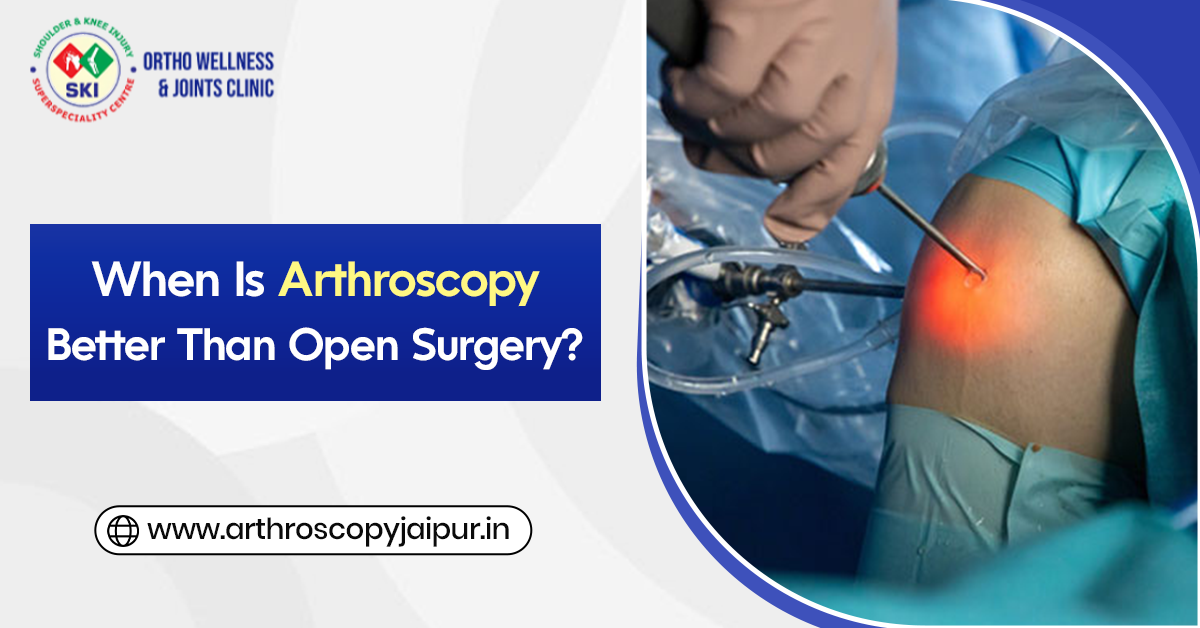
When Is Arthroscopy Better Than Open Surgery?
Introduction
Patients tend to consider the most suitable treatment method when they have some joint issues and need medical treatment. With the increased development of minimally invasive surgical techniques, the question of whether Arthroscopy Better Than Open Surgery is increasingly pertinent.
Arthroscopy has transformed the orthopedic surgery field because it provides patients with quicker recovery, less pain, and fewer incisions than traditional open surgery. This read will clearly discuss when arthroscopy is the better option and assist you in appreciating the benefits of this modernized operation procedure in relation to various joint disorders.
Understanding Both Types of Surgery
What Is Open Surgery?
The classical method of surgery performed by orthopedic surgeons is open surgery, which has also long been performed. In open surgery, the surgeon uses a large incision over the joint of interest to have full access to the surgical field.
The method enables the surgeon to observe the full structure of the joint, the surrounding tissues, muscles, and ligaments using the naked eye. Open surgery gives optimum visibility as well as access and is necessary in some of the tricky surgeries, such as complete joint replacements, a severe fracture that might need extensive reconstruction, or when the surgery involves the repair of more than two tissues at a time. The surgeon is able to operate using both hands and standard surgical equipment, which enables him to treat profound conditions.
What Is Arthroscopic Surgery?
Arthroscopy is a modern and minimally invasive surgical approach that involves the utilization of special devices that are used to reach and treat joint issues. In the arthroscopic procedures, the surgeon opens two to four small incisions, the size of which is between half an inch and one inch. An arthroscope is a small camera that is inserted into the body by means of a single incision, and it helps to view the inside of the joint on a screen in great detail.
The other small incisions are used to position special surgical tools to administer the amount of repair or treatment required. The procedure has revolutionized how patients are treated and recovered by enabling the surgeons to complete numerous tasks that would have otherwise taken them to make huge openings.
Advantages of Arthroscopy as compared to Open Surgery.
Majorly Minimized Tissue Destruction
The preservation of tissues is one of the major reasons why there is such a straightforward answer to the question of whether Arthroscopy is Better Than Open Surgery. Arthroscopy involves just small cuts, and thus the muscles, tendons, and soft tissues around the joint do not suffer much trauma. In open surgery, tremendous incisions are made across these tissues, resulting in considerable damage that needs to go through the healing process.
This preservation in arthroscopy also results in less inflammation, decreased postoperative pain, and overall quicker rate of recovery. Natural healing processes in the human body are more effective when there is minimal tissue trauma, which is a factor in high success in proper cases.
Faster Recovery Times Dramatically
Where the most dramatic difference can be found is in the recovery timeline: when is arthroscopy better than open surgery? Arthroscopic surgery usually ensures that the patient takes two to six weeks before their daily life returns to normal, depending on the type of surgery. The recovery time of an open surgery is normally between three and six months of restricted activity and rehabilitation.
The inference of recovery time is far-reaching with regard to the quality of life of patients, their capability to go back to work, and their overall productivity. The quick recovery arthroscopy that working persons and active patients enjoy is an added benefit.
Significantly less postoperative pain
Minimal tissue trauma with arthroscopy also means that patients have significantly less post-operative pain than with open surgery. The smaller cuts lead to less inflammation and nerve damage, hence the patients take fewer painkillers and enjoy sleep throughout the recovery process.
When pain decreases, it also promotes more indulgence in physical therapy and rehabilitation, further enhancing functional recovery. Such a decrease in pain will go a long way in enhancing the overall patient experience in the healing process.
Reduced chance of infection and complications
The tiny cuts to accomplish an arthroscopy bring a reduced risk of infection in comparison with the big surgical incisions made by the open surgery. Less blood loss during the operation since the incisions are smaller, eliminating the need to transfuse blood and any risks associated with the procedure.
Moreover, it is generally the case that arthroscopic procedures lead to less inflammation in the entire joint, which can help avert other complications such as stiffness and scar tissue formation that would limit joint functioning in the long-run.
Low Scarring and Cosmetic Advantages
Arthroscopy reduces scars to a small size that can be easily concealed, and it mostly diminishes with time. Open surgery produces large and visible scars that can always be seen. Arthroscopy is also obviously beneficial to a patient who cares about cosmetic looks, especially in the exposed parts, such as the shoulder or knee. The scarring is also minimal, resulting in limited scar tissue formation in the joint itself, which can limit movement in cases of open surgery.
Reduced Hospital Costs and Faster Hospital Discharge
Arthroscopic surgery is generally cheaper than open surgery since the time of operation and hospital stay is limited. Arthroscopy is done in many cases and is also done as an outpatient, and patients can go home the same day. The open surgical method is associated with generalized hospital stays and lengthy healing phases, which do greatly add to the total medical expenses and time lost from a normal lifestyle.
Better Long-term functional outcomes
When it is the right time to use arthroscopy over open surgery, patients tend to experience better functional results in the long term. The decreased tissue destruction, accelerated rehabilitation, and sooner restoration to activity are involved in improved joint functioning and power restoration. Arthroscoiled patients often report enhanced satisfaction with their surgery results and improved recovery back to activities they prefer.
Particular situations in which arthroscopy performs better
Arthroscopy is significantly superior in terms of meniscal tear, anterior cruciate ligament repair, rotator cuff repair, and cartilage injury repair. Evaluations to identify issues in joints are preferable to be done under arthroscopy. Arthroscopic procedures are effective in addressing a wide variety of conditions of the shoulder, knee, and ankle, making the technique the best option in the right patients.
About Dr. Abhishek Gupta: Expert Orthopedic Surgeon
Dr. Abhishek Gupta is a famous Joint replacement Doctor in Jaipur who has a vast experience in arthroscopic operations and sophisticated joint surgery. As the orthopedic surgeon who previously received specialized training at the facilities of the top-ranked institutions in terms of minimally invasive surgery usage, Dr. Gupta can offer the most recent surgery techniques and at the same time be a patient-centered surgeon.
His insight about when arthroscopy can outshine open surgery and the technical skills with which he can carry out a complicated arthroscopic procedure make sure that patients get the best surgery technique according to the unique situation.
Conclusion
The response to the question of whether Arthroscopy is Better Than Open Surgery is getting even more explicit with the development of technology and the mastery of surgeon skills. The above conditions are better served by arthroscopy, with the inclusion of spectacularly shortened healing times, immense reduction of pain, limited bleeding, low chances of infection, as well as enormous patient satisfaction. Although open surgery is still necessary in some complicated joint issues that may need large-scale reconstruction, a majority of the widespread orthopedic cases have their gold standard in arthroscopy. Whether the surgical approach used is correct, given the unique needs of each patient, allows orthopedic surgeons to maximize their outcomes and assist patients to get back to normal operations as soon and safely as possible.
FAQ
In what situations is arthroscopy superior to open surgery of knee issues?
Arthroscopy is usually preferable for meniscal tears, ACL reconstruction, cartilage, and diagnostic evaluation of the knee. The operation is incredibly effective with younger patients who have only isolated injuries, as it enables them to recover very fast and be included in sports and other activities. Nonetheless, severe osteoarthritis that necessitates joint replacement and complex fractures likely still need open surgery to achieve the best results.
Does arthroscopy fail more than open surgery?
No, arthroscopy has similar or better success rates with respect to open surgery when performed under the right conditions. The only difference is that one has to choose the appropriate procedure for the appropriate condition due to the diagnosis and the patient. The most appropriate approach for each case is decided by the surgeons, such as Dr. Abhishek Gupta.
Is it possible to change from arthroscopy to open surgery during the procedure?
Yes, the surgery can be safely converted in case, during arthroscopy, a surgeon decides that only open surgery is required to provide the best treatment. It is a norm and acceptable practice in situations in the course of the operation where there is clinical justification to change the surgical approach.
What is the rate of recovery following arthroscopy as compared to open surgery?
Arthroscopic recovery is faster than open surgery; two to four times faster. Whereas open surgery could take three to six months to recover, arthroscopy can, in most cases, offer an opportunity to resume normal lives within two to six weeks, depending on the nature of the procedure involved and the healing ability of the person.
Will arthroscopic surgery leave any scars?
There are a few scars since arthroscopy needs a few cutaneous slits. The cosmetic effect on most patients is amazing, as scars are virtually not seen or fade with time, as compared to the deep scars that come with an open surgical technique.


