


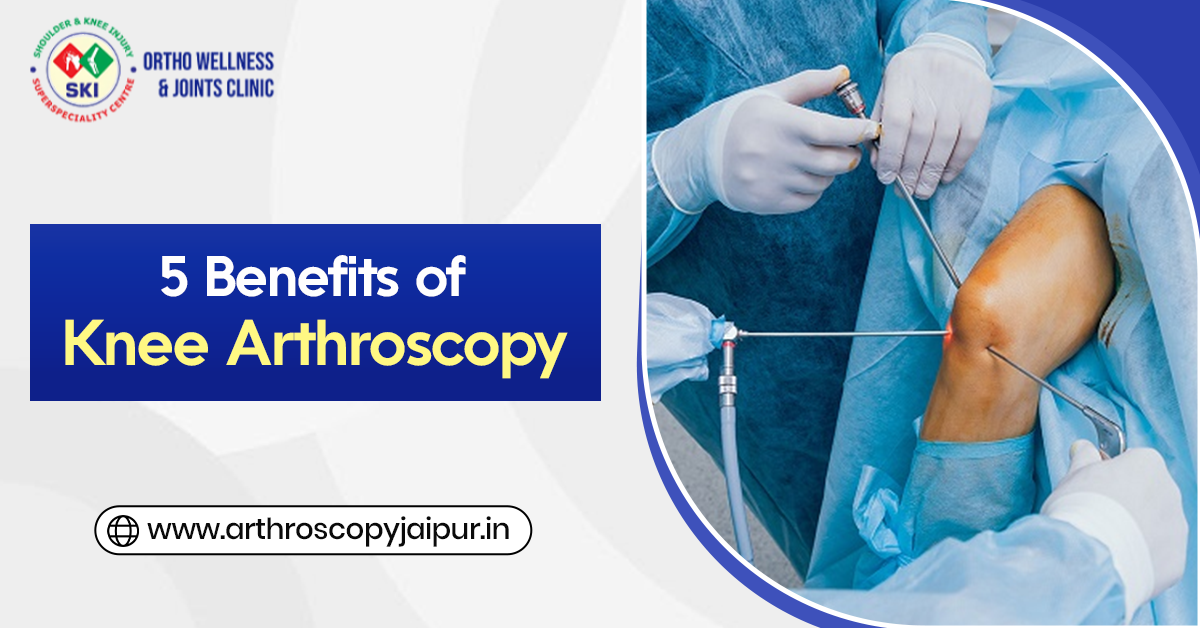
5 Benefits of Knee Arthroscopy
Introduction:
Knee pain turned out to be one of the most common orthopaedic complaints in India, afflicting all age groups — be it the young athlete who suffers from a ligament tear or a working professional suffering from arthritis or an elderly person with old-age degeneration. Whether from a sports injury, ligament tear or slow degradation of cartilage, chronic knee problems can diminish quality of life significantly. Fortunately, with advances in orthopaedic surgery, we now have a safe and effective minimally invasive procedure — knee arthroscopy.
If you (or anyone you know) are contemplating this procedure, here are the top five benefits of knee arthroscopy that ensure it is one of the most preferred surgical options today. In this read, we will help you to know the same in detail. Keep on reading to know more!
What Is Knee Arthroscopy?
Knee arthroscopy is a minimally invasive surgical technique that allows a small camera — known as an arthroscope — to be inserted into the knee joint through small incisions. This enables the surgeon to clearly see and treat the internal structures of the knee, such as ligament injuries, cartilage damage and meniscus tears with notch precision. The whole process generally requires 30 to 60 minutes and is done as a day-care surgery, which means patients return home the same day.
So, let us explore five knee arthroscopy surgery benefits that make this procedure the most preferred option.
Benefit 1 — Less Invasive with Small Incisions
Knee arthroscopy has the advantage of being one of the least invasive surgical procedures for a joint. Instead of big openings, surgeons create small incisions — only 0.8 to 1.0 cm deep. These small openings allow the arthroscope and surgical instruments to access the joint while preserving nearby healthy tissue, leading to less swelling and inflammation.
This represents a dramatic advance over conventional open knee surgery, which involves much larger incisions and inflicts far more damage to surrounding muscles and tissue. For patients, this equates to less bleeding, lower pain following surgery and overall a much better recovery process.
Benefit 2 – Quick Recovery and Early Resumption to Normal Life
One of the most celebrated benefits of knee arthroscopy surgery is how quickly patients are able to recover. Most patients can go back to work and regular activities in two months after the procedure, he says. And since the incisions are smaller, so are the scars compared with what you’d have after traditional knee surgery — and it will take less time for smaller ones to heal.
Bandages can be taken off a day or two post-surgery. Patients treated arthroscopically heal faster, rehabilitate quicker and return to activity and work more rapidly thereafter. This quicker turnaround is especially valuable for athletes and active people.
Benefit 3 — Diagnosis And Treatment In One Protocol
One of the unique and most useful benefits any knee arthroscopy procedure offers: it is a simultaneous diagnostic and treatment method. Knee arthroscopy allows the orthopaedic surgeon to diagnose the condition through the use of a camera (arthroscope) placed inside the knee joint for immediate treatment following diagnosis. This may involve removing free-floating bone fragments and repairing damaged cartilage, such as a torn meniscus.
That also means patients don’t have to undergo an additional procedure solely for a diagnosis. The surgeon evaluates the joint in real time and solves the issue in the same sitting — significantly reducing both total surgeries, costs and simplifying an overall treatment journey.
Benefit 4 — Minimised injury and complication rates
As arthroscopic knee surgery only makes small cuts, it causes the least amount of tissue damage, reduces scarring and can thus cause a more cosmetically pleasing result. Patients tend to report less pain after surgery and need fewer drugs to get rid of that pain.
The smaller the incision, the less the body’s internal environment is exposed to outside things — which directly means a lower risk of post-surgical infection. In contrast with minimally invasive arthroscopic procedures, the greater exposure of joints in open surgery delays recovery and increases pain and risk of complications like infection and arthrofibrosis. These benefits of knee arthroscopy are especially important for patients with baseline medical problems or patients who have concerns about surgical risk.
Benefit 5 — Provides Treatment for Numerous Knee Problems
Knee arthroscopy is not just a single condition — it is an extremely versatile procedure that can treat many knee issues in one surgical session. Commonly treated conditions may include a torn meniscus (repair, removal or reconstruction), ACL and PCL ligament reconstruction, damaged cartilage or loose cartilage, inflamed joint lining (synovitis), patella misalignment and removal of loose bone fragments.
Injuries that were once career-ending, especially in the athlete, are now treatable with arthroscopy, enabling patients to return to full function. This flexibility is why knee arthroscopy is a go-to option for an array of patients — from weekend cricketers to daily walkers.
Get the Best Knee Arthroscopy in Jaipur!
Are you suffering from knee pain, ligament injury, or cartilage damage and looking for expert arthroscopic care in Rajasthan? Dr. Abhishek Gupta is the best Arthroscopy Surgeon in Jaipur. He is one of the most experienced joint replacement surgeons in Jaipur and will decide between them based on the individual condition and high chances for a patient’s recovery without surgery.
Just reach him and be ready to take the steps that will help you to lead a better and pain free life.
Conclusion
In conclusion, more rapid healing and reduced risk of infection, dual diagnosis-and-treatment capabilities with far less scarring are the knee arthroscopy procedure benefits, making it perhaps the most patient-friendly surgical advance in orthopedics to date. When knee pain is restricting your movement and conservative treatment can no longer suffice, knee arthroscopy could be the optimal solution to deliver precise results.
FAQ
What are some advantages of knee arthroscopy compared to open surgery?
Besides the opportunity for accurate diagnosis and treatment that can be performed in a single procedure, knee arthroscopy has several advantages over open knee surgery including smaller incisions, more rapid recovery, less pain postoperatively, lower risk of infection and much less scarring.
How long is the recovery time following knee arthroscopy?
Most patients can do light daily activities several days afterwards and go back to work within 2 to 6 weeks. Athletes or people in physically demanding jobs might require 6 to 8 weeks before being able to return to full activity.
What type of procedure is Knee arthroscopy?
Yes. Knee arthroscopy is usually done as an outpatient or day-care procedure so that patients can go home the same day after the anaesthesia wears off.
Under what conditions can knee arthroscopy be used to treat?
Knee arthroscopy can be used to treat torn meniscus, ligament (ACL/PCL) tears, damaged cartilage/joint lining (synovitis), loose bone fragments and misaligned patella.
Are there age-related complications associated with knee arthroscopy?
Knee arthroscopy is typically safe and appropriate for a large number of patients. But it might be contraindicated in your case if you have severe osteoarthritis or other degenerative conditions. A full assessment from an orthopaedic surgeon will decide the best type of treatment for each patient.


